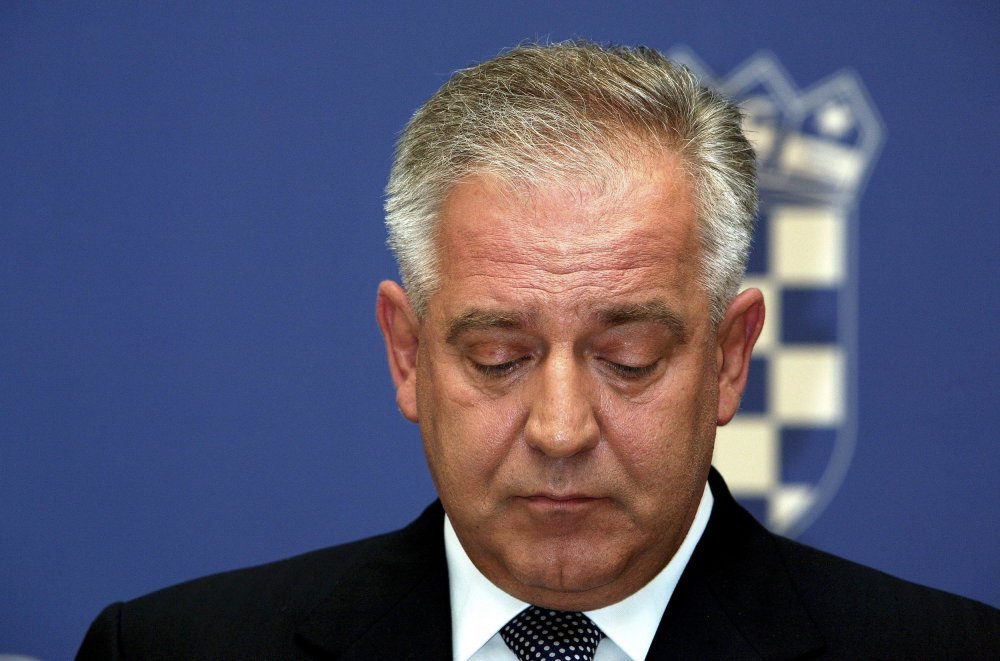

Former Croatian Prime Minister Ivo Sanader told a parliamentary commission investigating the privatisation of the national oil company INA on Tuesday that former Deputy Prime Minister Damir Polancec had personally briefed him, the government and the presidency of the Croatian Democratic Union (HDZ) about all stages of negotiations with Hungary's oil company MOL.
Answering a question from commission chair Dragica Zgrebec of the Social Democratic Party, Sanader confirmed that Polancec, acting at his recommendation, had informed Finance Minister Ivan Suker and Environmental Protection Minister Marina Matulovic Dropulic about draft agreements with MOL.
He denied having personally negotiated with MOL representatives.
The former PM said the initial agreement from 2003, whereby MOL acquired 25 percent plus one share in INA, had significantly determined the subsequent course of events, notably regarding managing rights in INA (the composition of its management and supervisory boards).
He said that he saw in the same context the situation when MOL, after buying shares from the initial public offering and those that were transferred to veterans and sold to INA employees, became INA's largest individual shareholder with a stake of more than 47 percent.
Speaking of amendments to the Shareholders' Agreement made during the term of his government, Sanader said they were the best possible solution at the time, because they helped the government to "practically keep all safeguards from the (initial) Shareholders' Agreement", even though the Croatian state was no longer INA's majority owner.
Zgrebec also wanted to know what he thought about the amendments having resulted in MOL gaining and Croatia losing four seats each in INA's management and supervisory boards even though the Hungarian oil and gas company did not become INA's majority owner, as had been envisaged by the 2003 agreement.
Sanader replied that the 2003 agreement also read that Croatia would lose four seats in the management and supervisory boards each once its share in INA fell below 50 percent plus one share, and that this was also the context of the fact that MOL gained bigger managing rights.
He described as a big success the fact that in talks with MOL, before amendments were made to the Shareholders' Agreement, Polancec had managed to negotiate for the Croatian government the right to pre-emptive buying of INA shares should MOL be the target of a hostile takeover. He also underlined as crucial the fact that the time frame within which MOL could not freely manage INA's shares without prior consent from the Croatian government had been extended until 2013.
Commission member Boris Kunst of the HDZ wanted to know if the government led by Social Democrat Ivica Racan, after spending large amounts of money to stabilise INA, should have sold the company, or if it was a bad decision, and if the money obtained by selling 25 percent plus one share in INA to MOL had really been spent on economic development.
Sanader said he believed that INA could not have survived on its own in the long run, because the state was not always the best of owners.
Maybe one should have invested in INA in such a way as to keep it a strong regional player, as it was in the former Yugoslavia, but that requires a change of mentality and greater aggressiveness on the market, Sanader said.
He went on to say that his government did not have time to analyse the work of the previous government and the investments it had made in INA.
"Citizens wanted us to start working," he told Kunst.
He also said that terminating the agreement with MOL would have been entirely wrong "because it would have sent a wrong message both to foreign and domestic investors".
"You are right about INA being a gold mine. I wish it could have stayed a strong regional player, but maybe we lack the strength, the strength to buy a foreign company, maybe we are too busy tripping one another up," Sanader said.