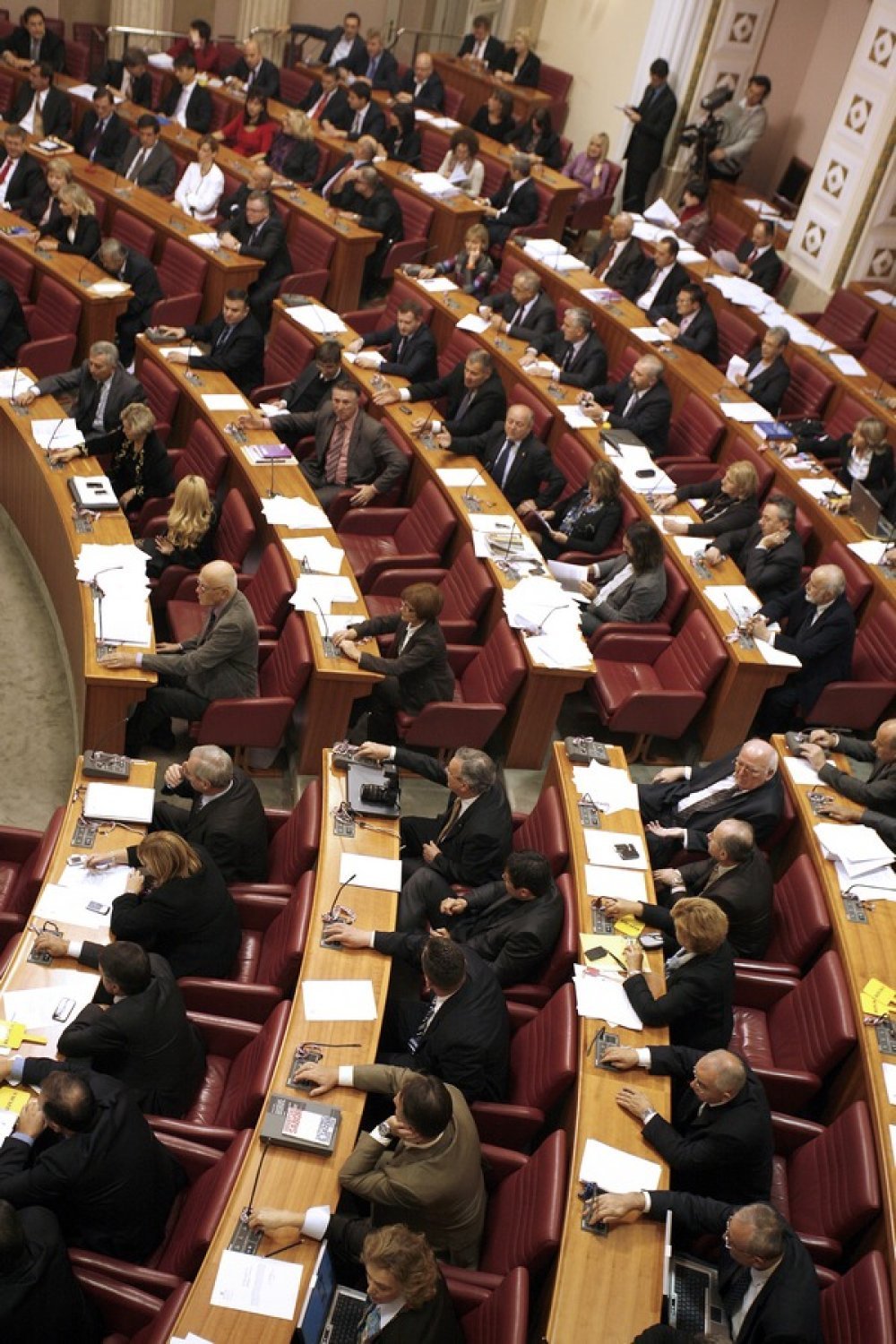

The Croatian Parliament on Friday adopted a decision on its dissolution, which marks the end of the work of the sixth parliament and based on which the President of the Republic will call elections for a new parliament which have been announced by the ruling coalition for December 4.
The decision on dissolving the parliament was supported by 135 deputies, one deputy abstained (Dragan Vukic of the ruling HDZ party), and one was against (minority MP Nazif Memedi).
The draft decision to dissolve the parliament was submitted by the ruling coalition parties - the Croatian Democratic Union (HDZ), the Croatian Peasant Party (HSS), the Independent Democratic Serb Party (SDSS) - and by the parliamentary group representing ethnic minorities and the group of independent MPs.
Under the Constitution, deputies are elected to the Sabor for a term of four years and elections for a new parliament are held within 60 days at the latest from the expiry of the parliament's term or its dissolution.
Since elections for the seventh parliament have been announced for December 4, the Parliament's Committee on the Constitution, Standing Orders and Political System put forward a proposal to dissolve the parliament which was adopted by the parliament today. The decision takes effect on the day of its adoption.
According to the Standing Orders, after the parliament is dissolved, the terms of its members continue and they end on the day a new parliament is constituted.
After the parliament is dissolved, the President of the Republic makes a decision to call elections for a new parliament. After the President calls elections, a period of 14 days starts running for the submission of lists of candidates to the State Election Commission and their verification.
At least 30 days must pass between the day elections are called and the day they are held, during which time the official election campaign takes place.
Under legislation on the transfer of powers, from the day elections are called onward, the government must not make decisions on new appointments, except in cases when acting officials are appointed to ensure the unimpeded functioning of state institutions.
The interim government also must not sign any agreements of greater value except in cases when failure to sign them would cause significant financial damage and if signing them is necessary to fulfil international obligations relating to activities to be completed by the time a new government takes office. Any agreement signed in contravention of this rule is considered null and void.
In the last parliamentary election, held on 25 November 2007, 153 deputies were elected to the parliament that was dissolved today.
Most parliamentary seats, 66, were won at the time by the HDZ, the Social Democratic Party (SDP) won 56 seats, the Croatian People's Party (HNS) 7, the HSS 6, ethnic minorities won 8 seats, including three won by the SDSS, the Istrian Democratic Party (IDS) and the Croatian Democratic Party of Slavonia and Baranja (HDSSB) won 3 seats each, the Croatian Social Liberal Party (HSLS) won two seats, and the Croatian Party of Rights (HSP) and the Croatian Pensioners Party (HSU) won one seat each.
The sixth parliament held 24 plenary sessions, adopting more than 800 laws and other acts, including some 300 laws adjusting national legislation to that of the European Union.
The sixth parliament was inaugurated on 11 January 2008, and the following day the parliamentary majority, consisting of the HDZ, the HSS, the SDSS, the HSLS, the HSU and deputies representing ethnic minorities, gave a vote of confidence to the government headed by HDZ president Ivo Sanader.
Sanader was Prime Minister until 1 July 2009, and five days later the parliament voted confidence in Jadranka Kosor as the new Prime Minister and in members of her government.
At the end of July that same year, the HSU walked out of the ruling coalition, and in July 2010 the HSLS did the same but its two MPs, Ivan Cehok and Antun Korosec, of whom the latter was standing in for the then Deputy PM Djurdja Adlesic in parliament, left the HSLS and supported Kosor's government as independent MPs, which resulted in the HSLS losing its status as a parliamentary party. The ruling coalition was also supported by former HNS member Zlatko Horvat, who together with Cehok and Adlesic makes the present parliamentary group of independent members of Parliament.
The parliamentary majority, namely its quorum in the parliament chamber, was brought into question in recent weeks as well, after the Opposition coalition led by the SDP boycotted the parliament and the SDSS MPs, too, refused to help secure a quorum.
After failing to secure a quorum for two weeks, the ruling coalition managed to do it a week ago, when 77 deputies, which is the number required for a quorum, voted on some 40 laws and decisions.