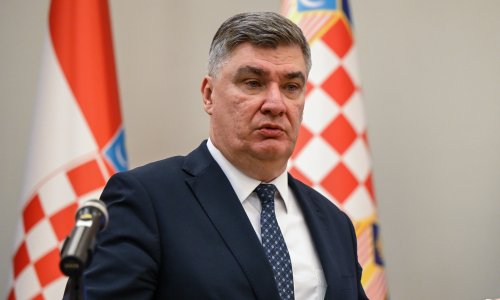


Radimir Cacic, leader of the Croatian People's Party (HNS) and future Deputy Prime Minister, said in the central news broadcast on Nova TV on Tuesday evening that the new government would adopt a budget for next year as soon as possible and that the budget would have to be smaller, as well as that earned pensions and salaries would not be touched.
He said that the budget for 2012 would be presented as soon as possible, possibly already in January, and that it would have to be smaller, both in absolute and relative terms.
"Pensions earned on the basis of years of service will not be touched. Salaries in the public administration will not be touched, but the wage budget will be reduced and the performance curve will be introduced. The current situation is like this - once you are employed in the public administration, you leave it when you retire, but that will change, meaning that employment will depend on one's quality and dismissal on one's lack of quality. And that will be evaluated every year," said Cacic.
Asked if that meant that salaries would not be reduced but that there would be lay-offs in the public administration, Cacic answered in the positive, adding that the government would take into account the current needs of the public administration and its future needs in light of the country's forthcoming EU entry.
"There will be no spectacular lay-offs of dozens of thousands of people," he added.
He said he expected directors of public companies to make their mandates available. "That's the least they can do. Citizens have given a mandate to the new government which has the right to all key functions," he said, adding that directors of public companies would have to work in line with the new government's programme and meet professional standards.
Asked by the programme's host if it would be more difficult to salvage the country's credit rating or deal with the lack of liquidity, Cacic said: "Both. Rating implies direct additional borrowing of around one billion euros, so if what is hanging over our heads becomes a reality, we would not gain anything and we would have an additional debt of one billion euros."
The future Deputy Prime Minister said he was very concerned about credit rating agencies' announcements that they would lower the credit rating of 15 European Union countries. "Our first priority is to adopt a set of reform measures and present it to key financial institutions," he said, adding that the measures would have to reflect on the budget.
Cacic said that together with Slavko Linic and Branko Grcic he would make up the government's team in charge of the economy.
Asked if the lack of liquidity today was worse than it had been in 2000, Cacic said that it was worse in absolute but not in relative figures, as evidenced by GDP and budget, and that it was much worse in terms of complexity.
"It is not only about the government's payments, but about the fact that companies are not paying one another and that in a number of cases the state is a major creditor," he said.
He recalled that in 2000 long-term loans were taken to salvage liquidity in the short term and that the same thing would be done now, regardless of the difficult conditions. "State obligations must be paid. A state which doesn't do it is not a state."
Cacic said that the biggest problem were companies that had been brought down to their knees by the current crisis and owed money to the state, paying interest on their debt. "The state must assume the obligations of a major creditor there. That's unfair in the eyes of those who have not been salvaged, but we have to decide, if 100 (companies) are in danger, we must save 85."
"If anyone is known for fast decision-making and action, that's Slavko Linic and me. Nothing will be done without Zoran Milanovic because the Prime Minister is the one to set the pace and strategy," Cacic said when asked if they had learned anything from the experience of the coalition government that came to power in 2000.
Asked what would happen if Croatia's credit rating declined, he said every possible effort would have to be made to raise it.