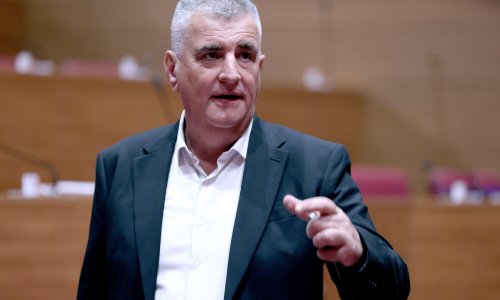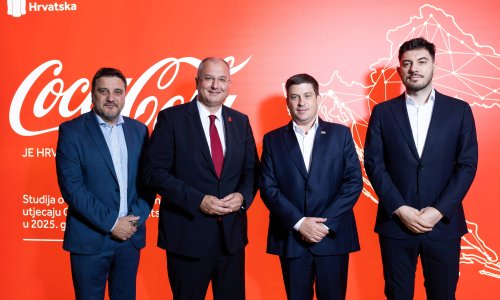


The visiting Serbian First Deputy Prime Minister Aleksandar Vucic said in Zagreb on Monday that Serbian-Croatian relations were "the backbone of the region" and pushed for more sincerity and credibility and less emotion in those relations.
"Croatia and Serbia are countries of key importance for the region, there is no need for emotions, our relations should be developed rationally and pragmatically," Vucic said at a news conference he held with his host in Zagreb, Croatia's First Deputy Prime Minister and Foreign Minister Vesna Pusic.
"I am not half as charming as some other Serbian politicians who visited Croatia in the past. However, I am sure that our relations in the future can be without much love but with more sincerity and credibility," said Vucic, who arrived for his first official visit to Zagreb.
Asked to comment on Serbian President Tomislav Nikolic's statement about the genocidal characteristic of Operation Storm in 1995 in which Croatia liberated its central and southern parts from Serb rebels, Vucic said that there were huge differences between Zagreb and Belgrade when it came to their positions regarding the past but he added that one should not insist on those differences.
"The differences should be recognised but they should not be insisted upon. I am sure that Mrs. Pusic and I, as well as all Croatian and Serbian officials do not view Operation Storm in the same way. But I do not think that it should be a barrier to our thoughts about the future. Eighteen years have passed, children have become fully-aged, and the future is more important than the past. Prospects of the development are more important than getting stuck in political ditches," Vucic said.
After their talks Croatian Deputy Prime Minister Pusic told the news conference that "the way is being paved" for talks on dropping genocide lawsuits which Croatia and Serbia had lodged against each other, given that serious steps had been made for the first time regarding the issue of people who went missing in the war.
"For the first time, serious steps have been made and serious headway is obviously ahead of us, which is paving the way for the talks on the possible withdrawal of genocide lawsuits," Pusic said.
"When we can see that we are moving forward regarding the issue of missing persons and that we are coming closer to a solution for that issue, then we are also closer to a point when we can discuss the withdrawal of lawsuits," said Pusic, who is also Croatia's foreign minister.
"It is not an easy matter for Serbia, but we are open to talks. I hope we will find a satisfactory solution," Vucic said.
Recently, Serbia provided Croatia with information about a mass grave in Vukovar's suburb of Sotin from which the remains of 13 civilian victims were subsequently unearthed. They had gone missing after Vukovar had fallen into the hands of Serb rebels and the then Yugoslav People's Army in 1991.
Pusic said today that she was grateful for information that helped efforts to identify the Sotin victims.
"Mr. Vucic said that Serbia is willing to cooperate, offering concrete information," she added.
The issue of those who are still unaccounted-for after they went missing in the war is "a human and emotionally-charged issue" which Zagreb cannot ignore, she said.
The data available to the Ministry of the Homeland Defence War Veterans' Affairs show that there are still 1703 people unaccounted-for since they went missing in the war. The recently discovered mass grave in Sotin was the 54th multiple grave in the eastern county of Vukovar bordering with Serbia.