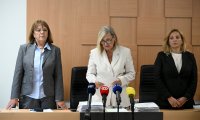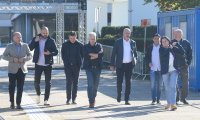

Representatives of Croatian opposition parties in the new parliament on Tuesday reached agreement on the division of seats in parliament's working bodies and committees, and their agreement is expected to be confirmed by the opposition parties' leaders on Wednesday morning so that later in the day those parties could sign an agreement on the matter.
Under today's agreement, which is based on the presumption of 29 working bodies and takes into consideration the possibility that the ruling coalition could reduce that number, 17 working bodies would go to the ruling coalition and 12 to the Opposition, with the Croatian Democratic Union (HDZ) chairing eight of the 12 bodies, while two would be chaired by the Croatian Labour Party and the Croatian Democratic Party of Slavonia and Baranja (HDSSB).
Branko Bacic of the HDZ told reporters after the meeting that the opposition had agreed on most issues, but that the agreement should be verified on Wednesday morning by the presidencies of the opposition parties.
The HDZ also insists on defining the number of deputies to represent Croatia in the European Parliament from the ranks of the Opposition, Bacic said.
He went on to say that the HDZ did not insist that all five opposition deputies in the European Parliament be from the HDZ, but that it wanted the ratio in the Croatian parliament to be respected, namely that seven deputies in the European Parliament be from the ruling coalition and five from the Opposition.
As for the question which opposition parties will contribute deputies to the European Parliament, talks will continue since a couple of options are open. According to one option, the HDZ would contribute four deputies and the HDSSB or the Labour Party one, while according to another option, the HDZ would contribute three deputies, and the HDSSB and the Labour Party one each.
Bacic would not answer a reporter's question whether scores were being settled with HDZ members criticising the party's election results.
Even though he said that the Opposition's proposals for the division of parliamentary working bodies had been finalised, Labour Party leader Dragutin Lesar said the opposition agreement was still based on 29 working bodies, which he said was not a final number, "because the ruling coalition has not submitted a list of parliament's working bodies, their names and scope."
He added that the Opposition was also entitled to the post of chair of the National Anti-Corruption Council, noting that the ruling coalition planned to reduce the number of parliamentary delegations from eight to seven.
Both Lesar and Dinko Buric of the HDSSB confirmed that it had been agreed that their parties would each have two chairs and two vice-chairs on parliamentary committees, as well as lead one parliamentary delegation or the National Anti-Corruption Council.
"I think we are close to an agreement, we are not interested in positions, but in the parliament starting to function normally, so that the government could start working too and the country could start pulling out of the crisis," said Buric.
Buric added that opposition parties were yet to agree on who would sit in the European Parliament on behalf of the Opposition. He said the HDSSB's proposal was that the HDZ should contribute three deputies and the HDSSB and the Labour Party one deputy each, or the HDZ four and the HDSSB and the Labour Party one deputy.