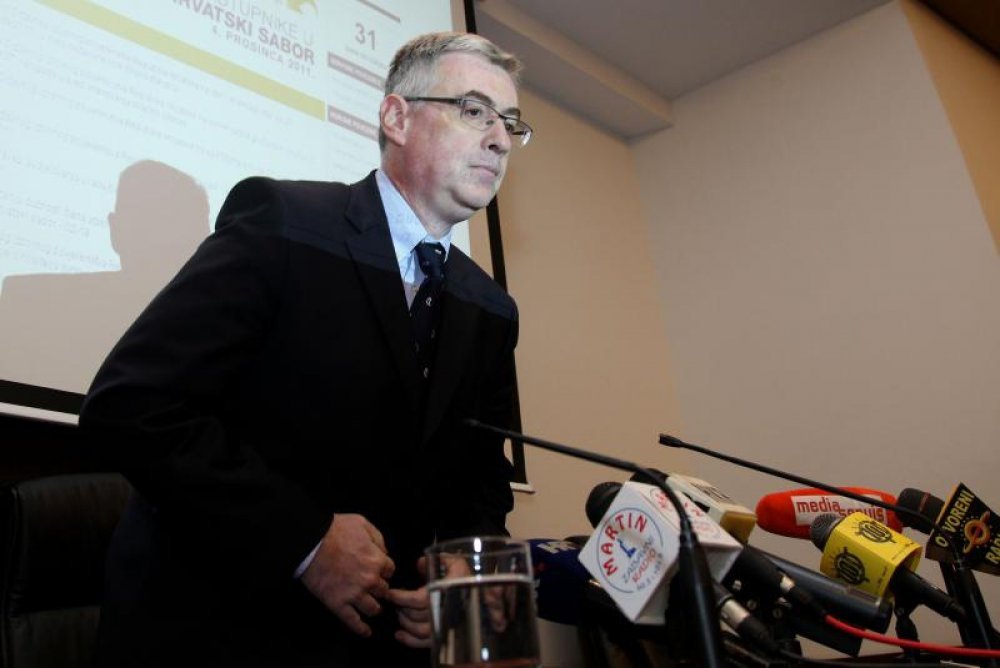

The president of the State Election Commission (DIP), Branko Hrvatin, said on Wednesday that it was in the interest of all, notably those organising the forthcoming parliamentary election, that citizens trusted the election process.
"Anything that casts suspicion on the election process is a problem for us. It is a sensitive matter, it can lead to speculation about the election result and the election process must be free of such things," Hrvatin said at a news conference at which he spoke about DIP's activities ahead of the December 4 parliamentary election.
Asked if he believed voter lists, Hrvatin said that as a citizen he had to believe state institutions and consequently accept voter lists that were compiled and approved by authorised institutions.
He added, however, that as a citizen he was very much interested in the structure of voter lists, particularly in what had been going on with them in recent years in constituencies, "but I can't obtain information on that either as a citizen or as DIP chair."
Hrvatin reported that DIP had received by the prescribed deadline 107 reports on the financing of election participants' campaigns (submitted by 57 political parties, 36 representatives of the ethnic minorities, and heads of 14 independent slates), while 14 reports were submitted after the expiry of the deadline.
Thirteen participants in the elections, including two political parties, did not submit reports on the financing of their election campaigns, and one party failed to open a separate bank account for the financing of its campaign, which it was expected to do under the election law.
Hrvatin said that as far as the financing of election campaigns was concerned, DIP had identified certain irregularities, particularly as regards donations by physical persons, and that it had sent documentation on those irregularities to the relevant municipal prosecutor's office.
Under the new law on the financing of political activities and election campaigns, which was adopted in February this year and which envisages stricter control of sources of financing and the way money is spent in election campaigns, the total amount of donations by a physical person to a political party, independent slate or candidate in one calendar year must not exceed 30,000 kuna, while the total amount of donations by a legal person must not exceed 200,000 kuna.
If the total amount of received donations exceeds the allowed amount, participants in elections have to return the amount that exceeds the limit to the donors.
Any amounts that exceed the donation limit and are not returned to the donors will have to be paid into the state budget.
"So far, 180,000 kuna has been paid into the budget and we'll see how this goes on," said Hrvatin.
A total of 4,504,081 voters have the right to take part in the December 4 election.
Of that number, 4,092,323 vote in eleven constituencies in Croatia, including 374,800 voters in Constituency No. 12 which is designed for the ethnic minorities. In the 2007 election, 4,073,294 voters were entitled to vote in those 11 constituencies, 19,029 fewer than in the forthcoming election.
In Constituency No. 11, which is designed for Croatian citizens without permanent residence in Croatia and which is commonly referred to as the diaspora electoral unit, 411,758 voters are entitled to vote, or 6,666 more than in the 2007 election.
The number of voters per constituency is the highest in Constituency No. 9 - 426,431 (as against 414,532 in 2007), and the lowest in Constituency No. 4, where 320,189 voters are entitled to vote, or 775 fewer than in 2007.
There will be 6,873 polling stations at 6,827 locations in the December 4 vote. A total of 5,164,500 ballots were printed and each of them is marked with a serial number and is treated as a banknote, said Hrvatin.
"DIP can say for every ballot, at any moment, at which polling station it is," Hrvatin said, confident that the secrecy of voting was guaranteed.
In Constituency No. 11, voters will vote in 52 countries. Thirty polling stations will be opened for out-of-country voting in Bosnia and Herzegovina, and 124 will be opened in other countries, including 19 in Germany.
Since there will be fewer polling stations in Bosnia and Herzegovina than in previous elections (9,000 voters per polling station), Hrvatin called on voters in Bosnia and Herzegovina to be patient during the voting.
DIP will publish preliminary election results at a news conference at midnight on the election day, Hrvatin said, adding that the speed of ballot counting might be slightly slower than in 2007 due to the large number of election participants and additional safeguards regarding data entry and verification.
On the election day, as of 2100 hours DIP will start publishing election results on its web site, updating them every 15 minutes. After midnight, a graph will be shown with slates which have passed the election threshold of 5 percent and the constituencies where they have passed it.
DIP will issue statements on the voter turnout at 1200 and 1700 hours, with the situation at 1100 and 1600 hours.
Asked if media discounts on election advertisements would be considered as donations, Hrvatin said that only media discounts which did not apply to all election participants would be considered as donations.
A possible donation of that kind has already been reported and we will look into it, he said.
Reporters also wanted to know how DIP would act in the case of candidates who are found to have been convicted for a criminal act which carries a prison sentence of more than six months. Hrvatin said that once it gathered all data on the candidates who had been elected to the parliament, DIP would decide if their terms could be approved in line with relevant legislation.