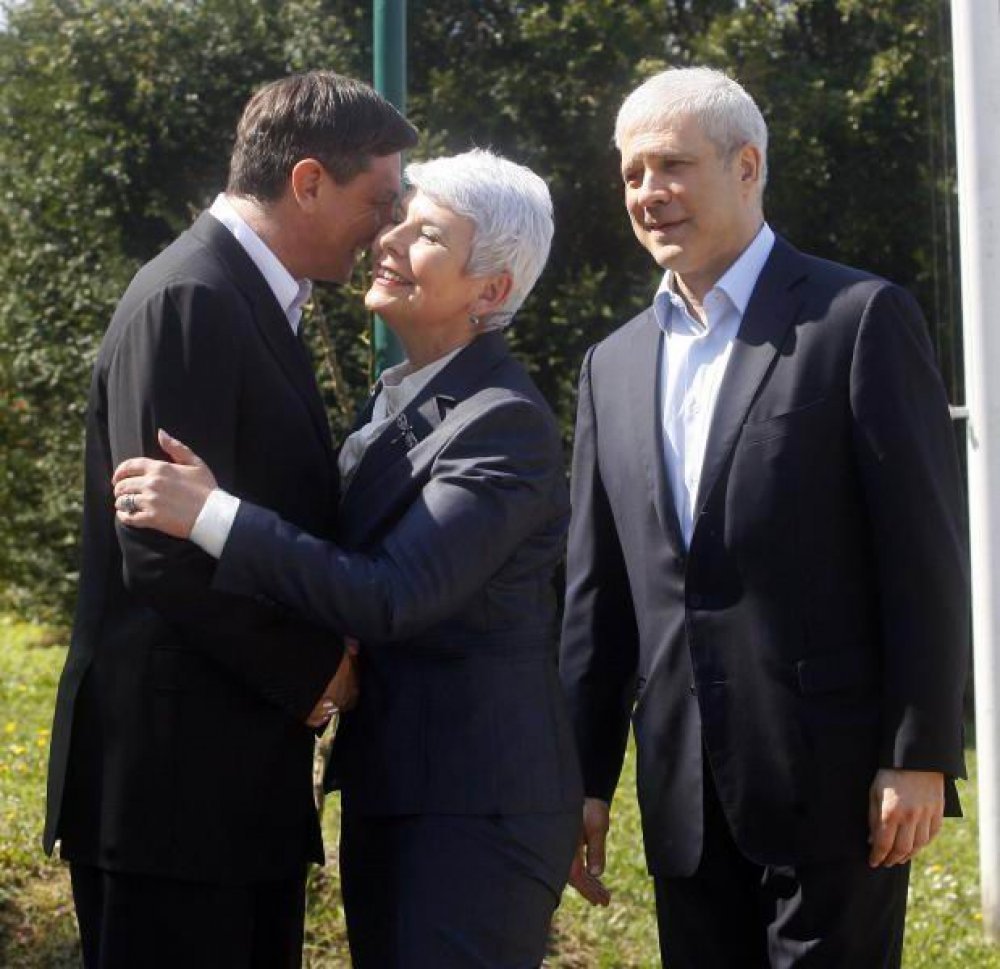

Serbian President Boris Tadic and the prime ministers of Croatia and Slovenia, Jadranka Kosor and Borut Pahor respectively, agreed at a trilateral meeting in the Serbian city of Smederevo on Friday to intensify economic cooperation and encourage cooperation in other areas for the sake of prosperity of the three countries and the entire region of Southeast Europe.
Addressing a joint press conference after the meeting, Kosor and Tadic expressed mutual support for the European integration of Croatia and Serbia, while Pahor said that Slovenia supported the completion of Croatia's EU accession negotiations and the granting of EU membership candidate status to Serbia.
"The completion of Croatia's negotiations with the EU is a good message for all our neighbours and entire Southeast Europe, because it confirms that reforms and all that work pay," Kosor said, adding that Croatia was capable of meeting the requirements for the completion of membership negotiations by the end of June.
Noting that good economic cooperation was extremely important for the stability of the region, Kosor cited the Cargo 10 railway project as an example of good cooperation between the three countries.
Speaking of the problem of missing persons from the 1991-1995 war, Kosor said that it was "the issue of all issues" for Croatia. She added that everything would be done to ensure that cases like that of Croatian war veteran Tihomir Purda, whom Serbia had accused of war crimes but later dropped the charges, did not happen again and that efforts would be made to form a working group that would examine each such case.
Tadic said that the Serbian judiciary would re-examine war crimes cases that had been taken over from previous military courts.
Kosor said that all three countries were ready to cooperate in combating organised crime, adding that high standards had been achieved in that regard.
Tadic said that Serbia's position was that the completion of Croatia's EU accession negotiations was good not only for Croatia, but also for the entire region, expressing "absolute support" to Croatia and its government in that regard. He said that Serbia was striving to win membership candidate status by the end of the year and to begin accession talks, stressing that Serbia supported the EU integration of the entire region.
Tadic said that the three countries supported closer economic cooperation and joint ventures on third markets. He also praised the establishment of the Cargo 10 company.
When asked if conditions had been met for Serbia and Croatia to withdraw their mutual lawsuits filed with the International Court of Justice, Tadic said that Serbia was ready for talks on the withdrawal of the suits, stressing that it was up to the governments of the two countries to decide on that and that the political atmosphere should also be taken into account.
Kosor said that the Croatian government had not discussed that issue, adding that the terms of previous agreements should be met, including the issue of prisoners of war and missing persons, and the return of cultural treasures.
Kosor announced that an international donors conference would be held in the second half of the year to raise funds for the housing of refugees and returnees.
Pahor said that as the representative of a country that is a member of the Council of the EU, he would push for the completion of EU accession negotiations with Croatia in June provided that Zagreb met all the requirements. He added that he would also advocate the granting of candidate status to Serbia by the end of the year if Belgrade fulfilled the necessary criteria.
Pahor said that it was important that the three countries settled their problems from the past faster, in good faith and peacefully. He announced that justice ministers from all countries in the region would meet in Brdo Pri Kranju, Slovenia, on April 15 to discuss cooperation in the common fight against organised crime.
Copies of a joint written statement were circulated to the press in which the three officials expressed their desire for stronger economic cooperation and joint ventures on third markets, noting that their statement provided a political framework for cooperation.
Construction, mechanical engineering, defence, automobile industry, wood processing, food industry, transport and communications were cited as potential areas of cooperation.
The statement said that the three countries would maintain regular communication to harmonise their efforts to that end.