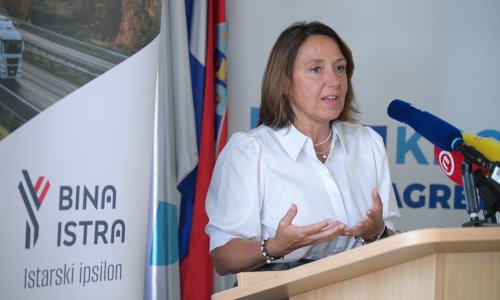


The Danube Strategy is a good framework for an efficient coordination of various cross-border projects and transnational programmes aimed at the development of the Danube river basin as well as the strengthening of good-neighbourly relations in the region, Croatian Prime Minister Jadranka Kosor said at the Danube river summit, held in Bucharest on Monday.
The summit on the Danube cooperation is attended by senior delegations of 14 countries and European Commission President Jose Manuel Barroso who said the possibilities created by the Danube Strategy were enormous, as the Danube runs through ten countries from Germany to the Black Sea and serves the population of 120 million.
The meeting in Bucharest has a symbolic value, Kosor said "as it marks the completion of the first phase of the development of the EU Strategy for the Danube Region and welcomes the beginning of the next, implementation phase, which will help us review the challenges and coordinate cross-border cooperation projects more efficiently."
"This primarily refers to the development and implementation of strategic projects in transport and energy infrastructure and an integrated management of the Danube waters, as well as economy, environmental protection and cultural projects," PM Kosor said.
Romanian Prime Minister Emil Boc called on local communities and regions to play an important role in this process.
"The Danube Strategy will be a good instruments for the realisation of this objective," Kosor said, adding that she expected the implementation of the strategy to have a significant impact on the further development and strengthening of good-neighbourly relations in the region and that will will help advance cooperation.
Kosor stressed Croatia was on the threshold of joining the European Union, adding that Croatia is "determined to bring additional value of the European Union, our efforts within the framework of the Danube Strategy will be aimed at confirming the strategy as the means connecting various national and cross-border policies, strengthening of inter-departmental cooperation and seeing that all available resources be used in the best way possible."
The Danube Strategy includes 14 countries -- EU members Germany, Austria, Slovakia, the Czech Republic, Hungary, Slovenia, Romania and Bulgaria and non-EU countries Bosnia and Herzegovina, Croatia, Moldova, Montenegro, Serbia and parts of Ukraine.
The Danube Strategy, along with the Action Plan, should be completed this week and presented on 8 December.
The main objectives of the Action Plan is to make the Danube navigable 300 days a year by 2020 and to increase cargo transport by 20 percent and complete railway networks between Danube region countries by 2030.
Greenhouse emissions should be reduced by 20 percent compared with 1990 and a share of the renewable energy sources in the overall energy consumption should go up 20 percent in relation to 1990.
The number of tourists coming from outside the region should go up 50 percent in relation to 2010.