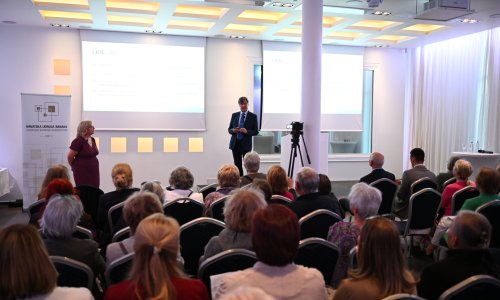

Croatian authorities have not carried out structural reforms or reached a consensus on the model of economic development, which is why the country's economy is having problems overcoming the crisis, the head of the Croatian Chamber of Commerce (HGK) macroeconomic analysis department, Jasna Belosevic Matic, said at a session of the HGK Assembly on Wednesday.
Speaking of the state of the national economy at the end of 2011, Belosevic Matic pointed to the slow pace of recovery, estimating that this year's annual GDP growth of 0.2 percent would not be sufficient to overcome the crisis and start recovery.
Only growth rates of three percent or more would mean that the national economy is recovering at the desired rate, she said.
The positive developments in tourism, retail trade and net export of commodities have apparently not provided a sufficiently strong impetus for a faster GDP growth, Belosevic Matic said.
She recalled that in the first nine months of this year industrial output went down 1.3 percent from the same period last year, while the construction sector saw a slowdown and personal consumption grew at low rates.
The current developments in European countries which are Croatia's main trade partners are not helping either, she said.
Since Croatia's problems are of a structural nature, it will not be possible to solve them soon, the HGK official said, adding that 2012 could be the year of a new beginning if serious reforms were launched and harmonised development strategies, oriented to production and import, were implemented in cooperation with the fiscal and monetary authorities.
HGK president Nadan Vidosevic said that Croatia's geographical position, which he said was interesting to emerging global economic powers, could provide a way out of the crisis.
A precondition for using that potential is a uniform state policy that is implemented by all, Vidosevic said.
The HGK Assembly also adopted a plan of work for 2012 focusing on the education of HGK members on changes resulting from Croatia's EU accession, assistance to businesses in entering foreign markets, and support for production and export growth.