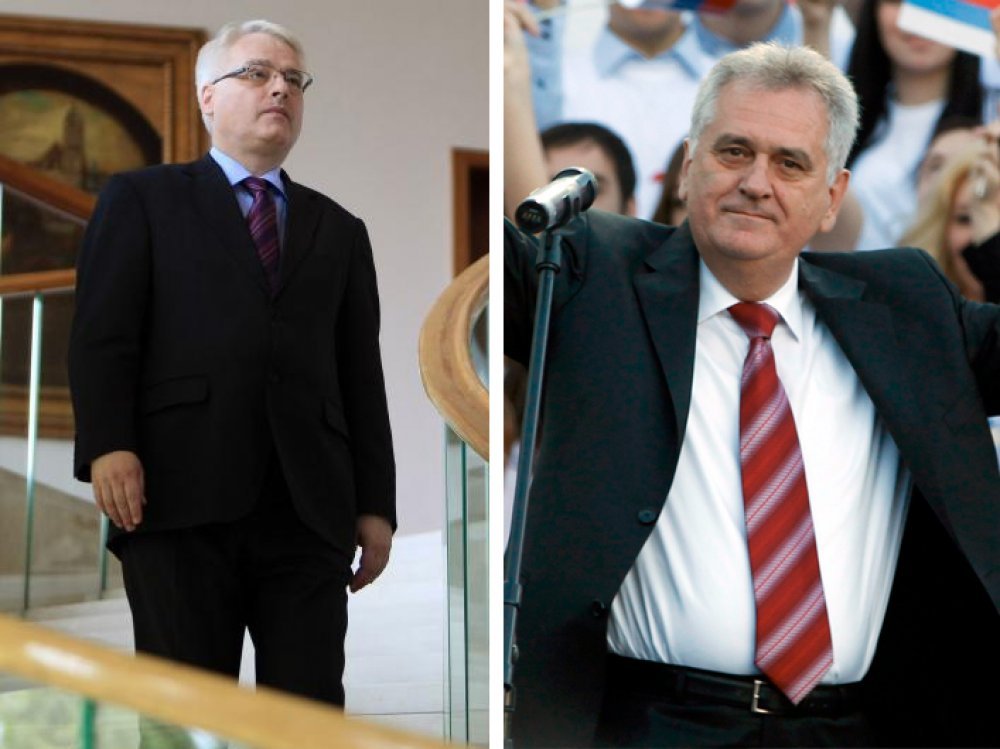

Croatian President Ivo Josipovic said on Friday that each society must go through a catharsis and recognise the good and the bad in politics, adding that neither Croatia nor Serbia would benefit from quarrels as good relations were important to both countries, saying however that his meeting with Serbian President Tomislav Nikolic would still not serve its purpose.
In an exclusive interview for the Belgrade-based B92 Television, Josipovic said that after certain statements Nikolic had made he doubted that their meeting "would results in a political consensus necessary for it to serve its purpose."
Commenting on his previous statement that the time had not yet come for his meeting with the Serbian president, Josipovic said his meetings with former Serbian president Boris Tadic "were always very symbolic and they were based on the fact that we have a fair share of common understanding of history, necessary for the future."
"In this case President Nikolic, who was legitimately elected and whom we in Croatia respect as the elected president of Serbia, has expressed certain positions because of which it is very difficult to expect that (our) meeting would have a symbolic meaning in Croatia or in Serbia," Josipovic said.
The Croatian president, however, expressed conviction that "the door has not been shut" recalling the statement by Serbian Prime Minister Ivica Dacic that "he did not want to create ice which generations to come would have to melt". Josipovic said Dacic's statement was encouraging.
Josipovic said he had a good cooperation with former Serbian president Boris Tadic with whom he remained friends.
"We were political partners and we became friends. Regardless of president Tadic's political future, he will always be my friend," Josipovic said.
Commenting on the ICTY acquittal of Croatian Generals Ante Gotovina and Mladen Markac, the 1990s war, Operation Storm, and prosecuting war crimes, Josipovic said that a catharsis was necessary.
"I think that every society must go through a catharsis and recognise what was good and what was bad in politics. We had a period (in our recent history) when we were confident that a crime cannot be committed if you are defending yourself. We have outgrown this phase. Now we are in the phase in which we are trying to treat all crimes equally, as much as this is possible," Josipovic said.
Commenting on the Serbian soldiers killed in Croatia, Josipovic said Serbia too needed a catharsis.
"When you speak of the killed soldiers, I am sorry that they were here, but I think it is time that people in Serbia ask themselves: Why were they here (in Croatia) anyway? Why were soldiers, tanks and aircraft sent from Serbia to Croatia? I believe this is question is part of the catharsis that you (Serbia) must go through," Josipovic said.
He added that Gotovina and Markac were acquitted by an independent international court which decided that the two generals had not committed war crimes.
"People were killed and houses were burned down, but the two generals are not responsible for that... Some were upset by that decision, but this is simply how it is and for Croatians those two individuals are actually the heroes of our defence, and not war criminals. This, of course, does not reduce Croatia's need to prosecute war crimes," Josipovic said.
He recalled that Croatia had prosecuted 104 people from the military and political circles, suspected of crimes against the Serb population.
"More than 30 people have been convicted so far, of whom three generals are serving long-term prison sentences," Josipovic said.
He explained that nobody has been indicted for crimes possibly committed in Operation Storm, because the trial was held before the UN war crimes tribunal at The Hague, adding that after the Gotovina and Markac trial ended, Croatia asked the tribunal to forward the case and evidence, announcing an investigation into possible crimes committed during Operation and trials.
Commenting on Croatia's policy towards the return of refugees, Josipovic said a total of 94,000 people from Serbia had returned to Croatia so far.
"The state of Croatia invested approximately EUR 5.5. billion in the return and housing of Croats and Serbs," Josipovic said.