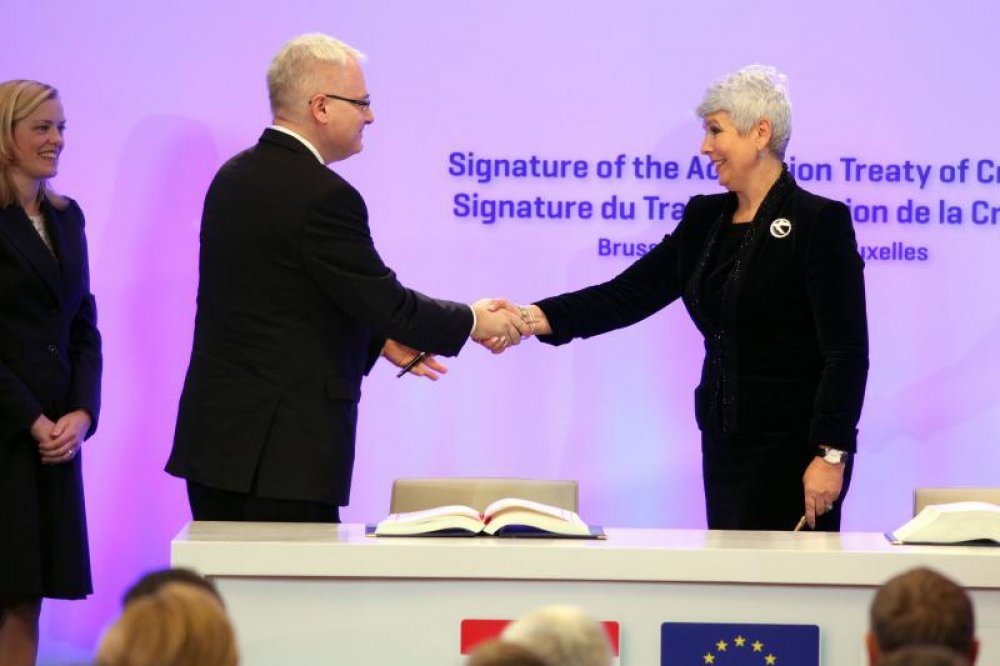

World and regional news agencies reported that Croatia signed an Accession Treaty with the European Union on Friday and would join in July 2013 as the 28th member, underlining that with its reform efforts, Croatia had shown the way the Western Balkans should follow.
Austria's APA released a timeline of the 10 years between Croatia's EU membership application and admission, listing all of Croatia's efforts and setbacks during the negotiations, as well as a feature on Croatia's border dispute with Slovenia.
Reporting from Brussels, APA quoted Croatian Prime Minister Jadranka Kosor as saying that by signing the treaty, "Croatia is returning to the home... it has always belong to."
The signing of the treaty is Croatia's "reward for deep democratic and economic reforms," said Reuters.
EU politicians "hope Croatia's membership will persuade other countries in the Balkans that reforms pay off and accelerate democratic transition," Reuters said, adding that this is what European Council President Herman Van Rompuy underlined in his speech at today's signing ceremony.
With the treaty signing, Croatia becomes a participant in most meetings of EU members and an active observer, beginning with today's summit, said Slovenia's STA.
The agency said that in her speech, Kosor recalled Slovenia's blockade of Croatia's EU entry talks in 2009 and that she said she was "happy to have solved that 18-year-old outstanding issue with her Slovenian counterpart Borut Pahor."
"Croatia is a pioneer, demonstrating that the future of the Western Balkans as a whole lies in the EU," Reuters said, while France's AFP quoted Van Rompuy as saying that reforms must continue until the day of accession.
AFP said Croatia's accession negotiations had been very long and that the EU, learning after the quick admission of the insufficiently prepared Bulgaria and Romania, had changed the monitoring system for Croatia, hoping that it would carry on with reforms until July 2013.
Serbia's Beta quoted Croatian President Ivo Josipovic as saying Zagreb was committed to carrying on with reforms with new impetus.
The agency also quoted Kosor as saying that today's signing was the "culmination of Croatia's recognition on the international scene," that "Croatian becomes the EU's 24th official language," that "Croatia is opening the doors to neighbouring countries to enter the EU" and would "support their reform efforts."
Serbia's Tanjug said European Parliament President Jerzy Buzek expected Croatian citizens to vote for EU accession at a forthcoming referendum and Croatia to be a model in the region.
The agency quoted European Commission President Jose Manuel Barroso as saying Croatia provided the best proof that the EU's enlargement policy was strong and successful.