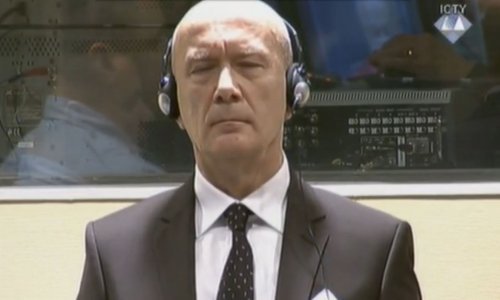

In its latest filing to the Appeals Chamber of the Hague war crimes tribunal, defence counsel for Croatian General Ante Gotovina says that the Appeals Chamber should admit 25 additional documents because they constitute new evidence that would have changed the trial court ruling had they been available to the court, thus dismissing the prosecution's arguments opposing the admission of new evidence, the Hague tribunal said on Monday.
The defence team representing Gotovina before the International Criminal Tribunal for the former Yugoslavia (ICTY) on November 4 filed a motion to introduce new evidence in the appeal, including the minutes of meetings of the Serbian Supreme Defence Council held in Belgrade during a Croatian military offensive known as Operation Storm in the summer of 1995, U.S. diplomatic dispatches released by the whistle-blower website WikiLeaks, and expert reports by US officers.
The additional evidence pertains to the departure of Serb civilians before, during and after Operation Storm, the nature of Croatian Army artillery attacks during the offensive and Gotovina's authority to make public statements.
The tribunal's rules allow for the introduction of only such evidence that was not available at trial and that could have impacted the trial court ruling.
The prosecution said in its response to the defence motion that most of the evidence in question or similar documents had been available to the defence at trial and that the defence did not show in its motion that the evidence could have changed the trial court ruling had it been introduced at trial.
"The Prosecution's Response ignores the central theme that runs throughout much of the new evidence. In the days and weeks after Storm, all Serbs with knowledge of those events knew that the departure of Serb civilians from Croatia was not caused by Croatian artillery. From Slobodan Milosevic, through the Yugoslav Army intelligence service, SVK Military Officers, SVK political officials, no one mentioned artillery as a motivation for departure. This common, contemporaneous assessment was corroborated by US Ambassador Galbraith," the defence says in its reply brief.
"The proposed additional evidence demonstrates, when considered individually and as a whole, the unreasonableness of the Trial Chamber's construction," the defence says.
The defence dismisses the prosecution's argument that the minutes of meetings of the Serbian Supreme Defence Council were available to the defence, underlining that they were in the possession of the prosecution which failed to disclose them to the defence as exculpatory evidence, in violation of the tribunal's rules.
"All of the Category I documents could have impacted the verdict because they establish not only that the evacuation order (from the rebel Serb leadership) was the primary and direct cause of departure, but also because they establish that the HV artillery attack was not," the defence says in its filing.
On April 15, General Gotovina and General Mladen Markac were sentenced to 24 years and 18 years in prison respectively for war crimes committed by Croatian forces against Serb civilians in occupied areas of Croatia during and after Operation Storm. The two generals' defence teams appealed on August 1.
The trial chamber established the expulsion of the Serb population committed through random artillery attacks that sent civilians fleeing, thus dismissing the defence's evidence that the rebel Serb authorities had called for the evacuation of civilians and that the artillery attacks were directed against military targets.