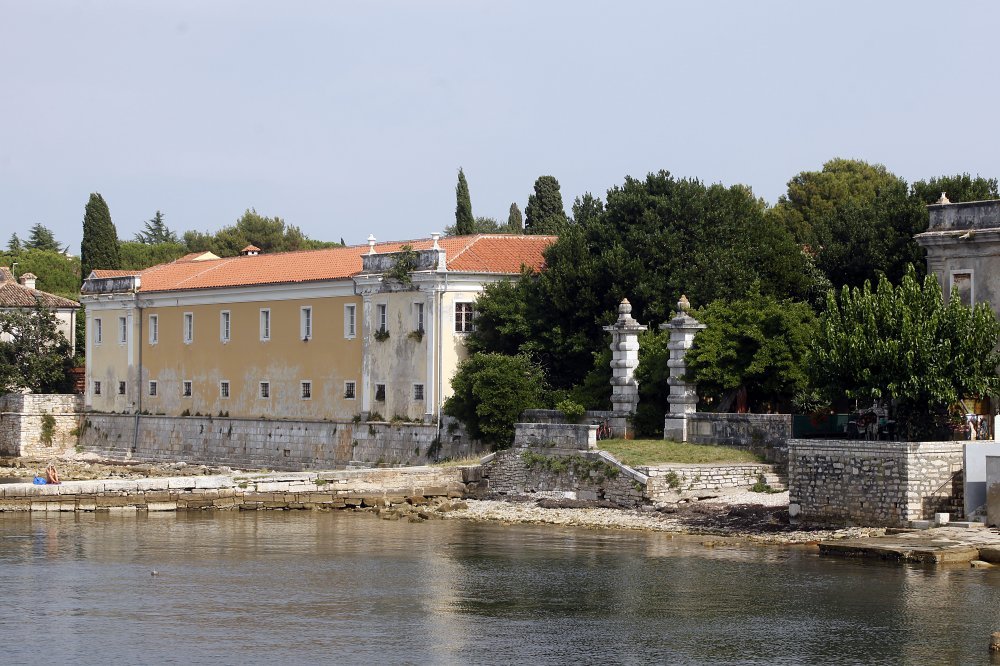

A group of Croatian Catholic intellectuals on Saturday issued a statement about a property dispute in the northern Adriatic parish of Dajla, saying that the dispute was not an exclusively church matter.
They recall in the statement that Benedictine monks from the Italian Abbey of Praglia have lost all court cases whereby they tried to register ownership of the real estate of the Dajla parish to the company Abbazia d.o.o., which they established in Croatia for that purpose.
According to the statement, compensation for the confiscated church property in Dajla was paid long ago under the 1975 Treaty of Osimo which the Republic of Croatia complied with entirely. The real estate, which under the treaty became State property, was restored by the State to the Church, the Dajla parish and the Diocese of Pula and Porec.
The state authorities did so even though they were not obliged to restore the property in question, and now the Benedictine order from Praglia "has decided that time has come to claim ownership of the said property, relying on canon law and Italian lobbying circles in the Vatican."
A papal commission, citing exclusively canon law, made a decision (on the restoration of the Dajla parish property to the Benedictines from Praglia) which is to the detriment of the Diocese of Porec and Pula and which has been met with dissatisfaction throughout Croatia, the statement says.
"If the Republic of Croatia had wanted to do it, it would have restored the real estate to the Benedictines. It restored it to the local diocese in its entirety. That is a fact that cannot be interpreted the way one chooses."
"If in this case Italians turn out to have the most influence in the Vatican, then it seems to us that they have decided to seize a part of the Primorje and Dalmatia regions, with the Dajla case being only the beginning. And so Croatia is a winner in the defence of its freedom in the battlefield, but is increasingly losing its influence at negotiating tables."
The statement was signed by 60 Catholic intellectuals, including the members of the Croatian Academy of Arts and Sciences Josip Pecaric, Stanko Popovic and Slaven Barisic, university professors Branimir Luksic and Marijan Sunjic, and former ambassador Ive Livljanic.