
Prime Minister Jadranka Kosor said on Monday that the government was planning to launch initiatives already this week to refute the unacceptable allegation of a joint criminal enterprise during appellate proceedings in the case of Croatian generals Ante Gotovina and Mladen Markac before the UN war crimes tribunal in The Hague.
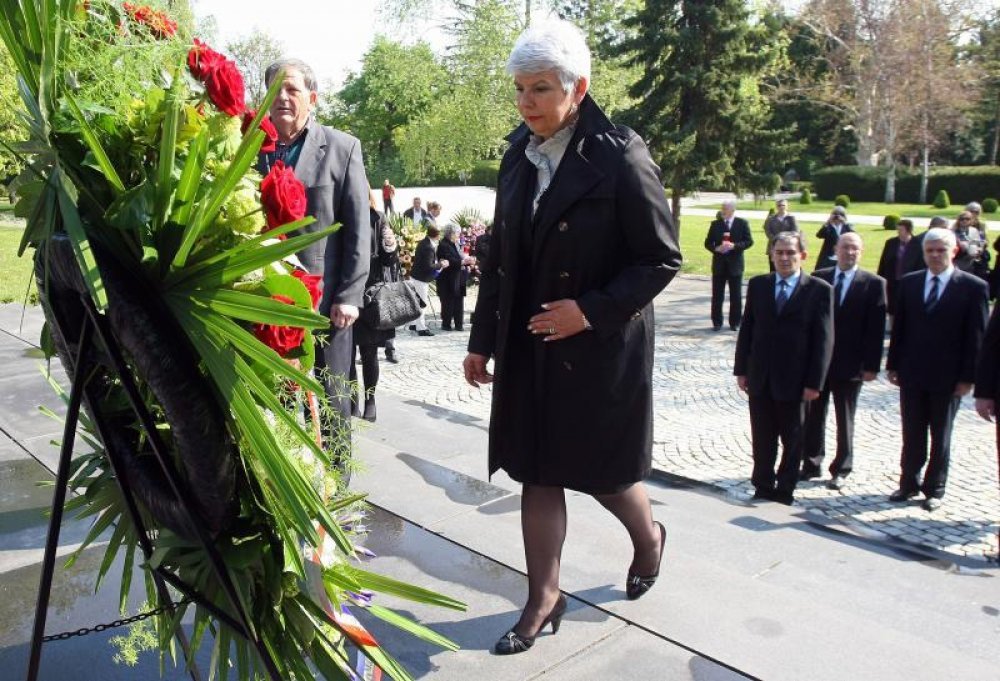
Kosor was speaking to reporters after a traditional pre-Easter ceremony at Zagreb's Mirogoj Cemetery where she laid wreaths and lit candles in tribute to unidentified victims of the 1991-1995 Homeland War. She was accompanied by representatives of missing persons' associations, Veterans' Affairs Minister Tomislav Ivic and Justice Minister Davor Bozinovic.
Kosor said that she had not yet met with lawyers representing the two generals, and added that the government was preparing an application for the status of amicus curiae, or friend of the court. She recalled that a previous such application had been turned down, but stressed that the government would do all in its power to ensure that the renewed application was granted.
The Prime Minister said that the government was also preparing at other levels, citing a study by the Croatian Academy of Legal Sciences entitled "Theory of Joint Criminal Enterprise and International Criminal Law - Challenges and Controversies", which had been distributed to foreign embassies and diplomatic missions.
"Diplomatic action has begun, first and foremost to explain facts. We will continue to insist on facts, because we believe that facts are the strongest and most important argument," Kosor said.
Speaking of the issue of people still unaccounted-for from the war, Kosor said it was still a priority for her government. "We must not and no one has the right, at any level and especially at the government level, to get tired of searching for the truth and seeking information that will shed light on the fate of all 1,013 people still listed as missing from 1991 and 1992."
Kosor recalled that during her recent talks with Serbian President Boris Tadic and Prime Minister Mirko Cvetkovic she had made it clear that Croatia considered the missing persons issue "the issue of all issues" and that all Croatian-Serbian talks should deal with it. She said that it was the biggest humanitarian and human rights problem because "every family has the right to know the truth."
The chairman of the federation of missing persons' associations, Ivan Psenica, said that the associations were planning to organise an international conference on missing persons this year. He said that the conference would bring together all relevant people from the region in an effort to locate the whereabouts of records on missing persons.
Psenica said that Serbia was still manipulating the issue, adding that the documents delivered to Croatia during Tadic's visit to Vukovar last November contained little useful information.