
The Croatian Labour Party on Wednesday accused the Croatian People's Party (HNS), one of the parties of the ruling coalition, and its leader Radimir Cacic of trying to assume control of the public broadcaster HRT behind the back of its coalition partner, the Social Democratic Party, and in collusion with the HRT management and the marketing agency Digitel.
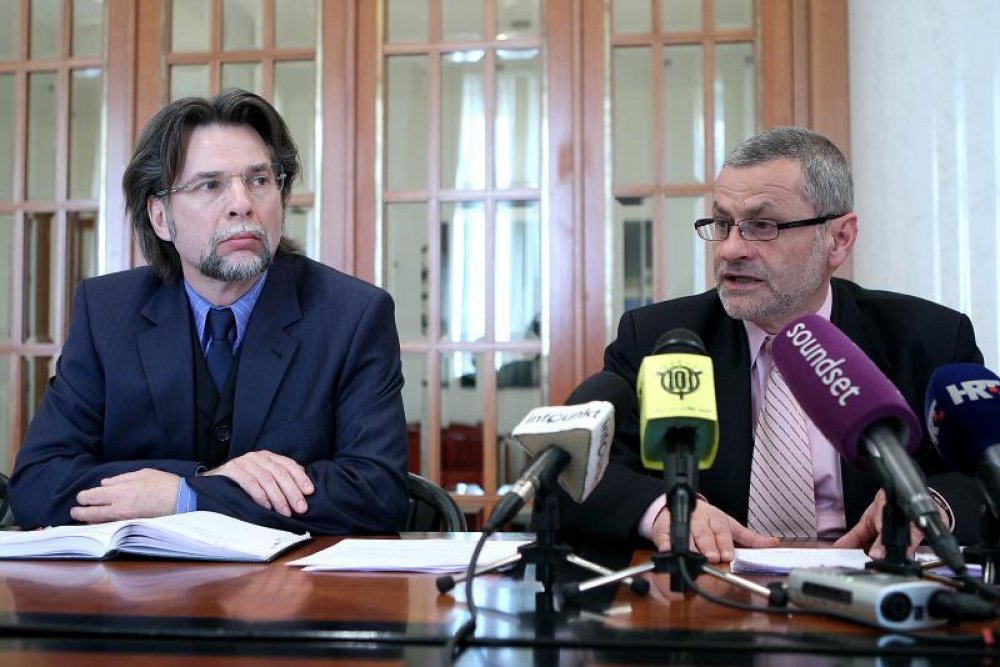
Labour Party officials held a news conference in the parliament building to present their draft bill on the HRT, which they said they had unsuccessfully tried to agree with the government. An attempt by the HNS to take over management of the HRT is, in their opinion, the reason why the government has still not forwarded the bill to parliament.
Asked if he thought that Cacic and Culture Minister Andrea Zlatar of the HNS were equally responsible for what he was accusing them of, Labour Party leader Dragutin Lesar said their responsibility should be established by Prime Minister Zoran Milanovic.
He said that the HRT was in a crisis both in terms of its management and its programming policy, that the Programming Council was falling apart, that the Supervisory Board and the Management Board were in a "latent conflict", and that the HRT's personnel policy was conducted by "grey eminences" at the HRT and "various PR advisors of some government members and ministers."
Asked about the grey eminences outside the HRT, Lesar said the most prominent was Ankica Mamic, owner of the marketing agency IM&C and Cacic's close associate.
Lesar believes that the HRT has entered into a war with commercial TV stations, thus ceasing to be a public television, which he says is evidenced by the low quality of its drama, educational, cultural and news programmes.
He said this had prompted the Labour Party to talk to a number of HRT representatives and conclude that parliament must use its powers to preserve the HRT as a public service. The party therefore launched talks with Culture Minister Andrea Zlatar on drawing up legislative changes which the ministry was to have put forward to the government.
Lesar said that legislative frameworks had been agreed at the talks, but that in the meantime a bill appeared in the media that had nothing to do with the Labour Party's proposal, "one that Lukashenko would not be ashamed of", while its authorship was ascribed to the Labour Party, which was criticised for trying to take over the HRT.
Lesar said that this was why his party submitted to parliament its bill on the HRT on Tuesday, expecting it to be included on the agenda of the coming parliamentary session.
Labour Party member Branko Vuksic, who chairs the parliamentary Committee on the Media, presented some of the changes proposed by the Labour Party's HRT bill. He said that the HRT's Supervisory Board, which would supervise the operation of the public broadcaster, and the HRT Directorate, would be appointed by parliament. The Supervisory Board would have the power to appoint, based on an invitation for applications, an HRT director-general.
An 11-member Programming Council would be appointed by parliament, following an invitation for applications announced by the Media Committee.
The Programming Council would elect editors-in-chief, who would have to apply for those positions in a public procedure, and all candidates for editors-in-chief would have to present their platforms before reporters and the Council.
An editor-in-chief selected by the Programming Council would have to be supported by 50 percent of HRT reporters plus one vote, and their opinion would be binding, according to the Labour Party's bill.