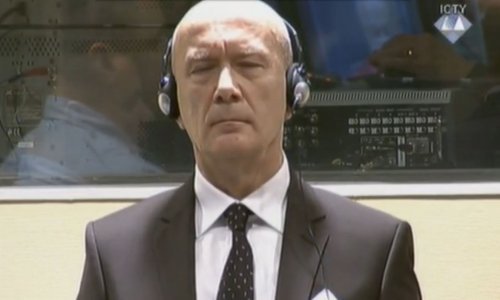
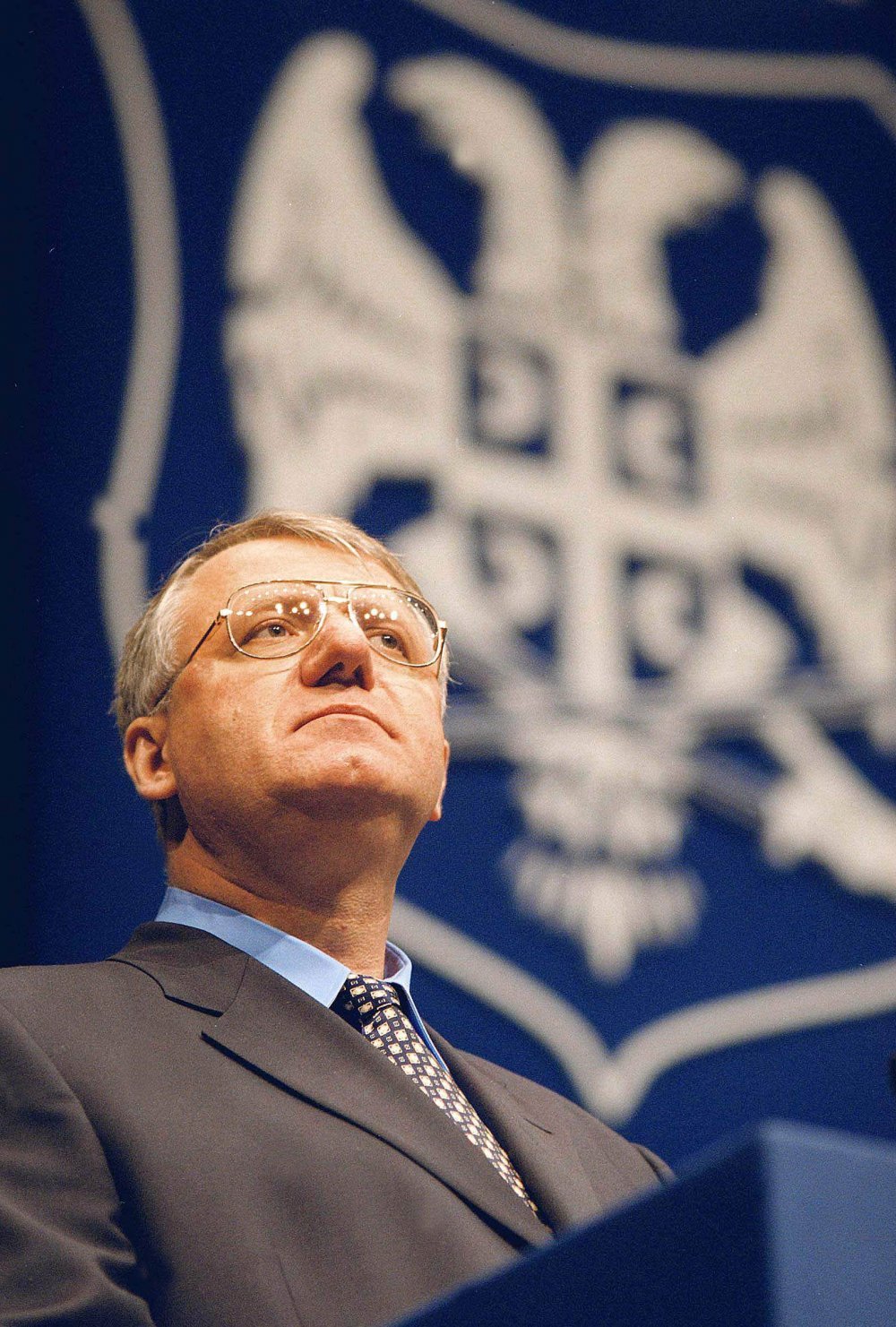

The International Criminal Tribunal for the former Yugoslavia (ICTY) is scheduled to announce on Wednesday its ruling on the request by Serbian Radical leader Vojislav Seselj, accused of war crimes in Croatia, Bosnia and Herzegovina, and the northern Serbian province of Vojvodina, that the indictment against him be dismissed.
Seselj filed the request based on ICTY regulations which allow the defendant, after the prosecution is finished with introducing evidence, to explain to the Trial Chamber why he/she believed that the prosecutors failed to prove his/her responsibility.
The hearing at which Seselj explained his request was held on March 7-9.
He then asked the Hague war crimes tribunal to acquit him, claiming the prosecution did not prove any of the crimes he was charged with, and that he be paid one million euros in damages for the eight years spent in the tribunal's custody.
Seselj said it was clear there was no evidence that could serve as the basis of a conviction and asked the UN court to acquit him.
Seselj also asked for damages for the eight-year custody, which he said was groundless, and everything he had gone through during this time, including being denied the right to represent himself, for his impaired health and, as he said, for the interruption of a political career that was on the rise.
The prosecution accused Seselj, alongside others involved in a criminal enterprise led by former Yugoslav President Slobodan Milosevic, of attempting to establish a new Serb state on Croatian, Bosnian and even Serbian territory via state-sponsored persecution which included killing, deportation, mistreatment, plunder and destruction of Croat and Muslim property.
Seselj is accused of crimes against humanity in Bosnia and Croatia, in particular of massacres at Ovcara and Vocin in Croatia and the expulsion of Croats from Vojvodina.
According to the prosecution, he advocated in public speeches the notion of a Greater Serbia, whose western border would run along the Virovitica-Karlovac-Karlobag line in Croatia, and with his extreme rhetoric he mobilised not only the armed SNS volunteer units under him, but other Serb forces as well, inciting them to persecute Croats and Muslims.
The prosecution introduced as evidence many of his inflammatory speeches and footage of him, in uniform or civilian clothing, visiting Serbian volunteer units which he incited to plunder and commit crimes in Croatia and Bosnia. In those videos, Seselj says he has mobilised SNS volunteers and sent them to Serbian lands in Croatia and Bosnia.
The prosecution called to the stand many victims, including survivors of the Ovcara and Vocin atrocities in which Seselj's volunteers took part, as well as Croats from Hrtkovci in Vojvodina, who started leaving in fear and under threat, after a speech in parliament in Belgrade in April 1992, in which Seselj advocated the expulsion of Croats from Vojvodina, and a rally in Hrtkovci the following May, when a list of the Croats and the Hungarians who had to leave was read out.
Seselj told the tribunal he had never given a hate speech and that neither he nor the SRS volunteers could be accused of any crime.