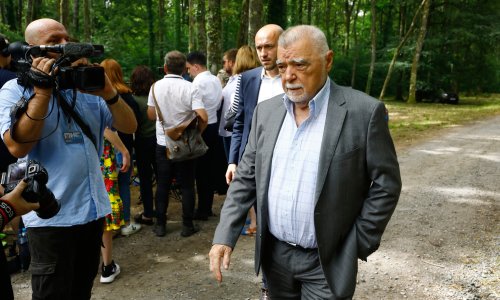
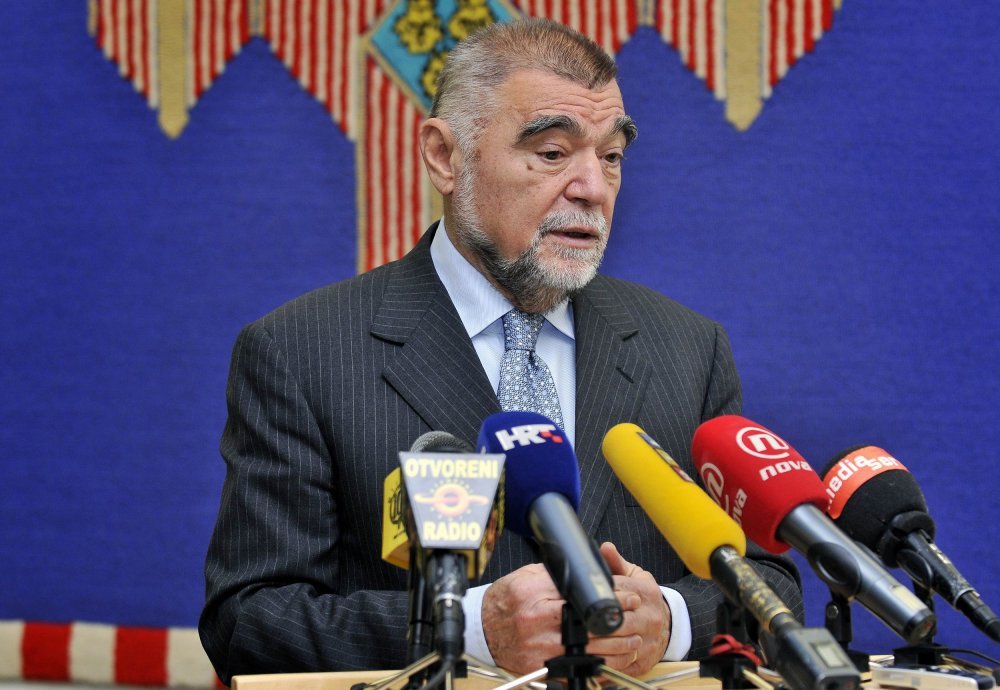

In his last televised address as President of Croatia, Stjepan Mesic thanked citizens for their support and confidence they had given him in the last ten years, and stated that he was leaving satisfied that he had launched important processes, describing his two consecutive five-year terms in office as "the first section of the road of unavoidable changes".
"I think I may say that I have contributed to radical changes in Croatia and to changes of the perception of Croatia in the world," Mesic said in his address to the nation, aired by the national broadcaster HTV on Tuesday evening.
The outgoing president said he had always taken into account Croatia's long-term interests.
"Perhaps some will criticise me for using the word "I" too often. However, this evening, at the end of my term, I can and must say that I have done certain things on my own, with the help of my aides of course, but without the support of the government and sometimes even against the will of the government that did not have enough political courage or political vision to follow me," Mesic said.
Mesic said that at the time he stepped into office ten years ago Croatia "was practically under international isolation" and now it was a NATO member and on the threshold of becoming a member of the European Union.
"Facing the resistance that was not at all weak, I have managed to impose new models of perception not only of the cooperation with the Hague tribunal but also of our recent past and what happened then. I have imposed, and I must emphasise this, I have imposed the concept of individualising the guilt for war crimes committed, thus eliminating the danger of the entire Croatian people being stigmatised for crimes committed by individuals who were hiding behind the Croatian name," Mesic said.
He said that although facing "vocal and aggressive resistance" he had also dealt with the treatment of anti-fascism as one of "the brightest pages in our recent history," adding that he insisted on transforming Croatia from a country where laws were applied selectively into a country upholding the rule of law.
"Significant steps have been made in this area, but we have not yet reached our final goal," Mesic said adding that the intensified clampdown on corruption and organised crime in the recent months as well as the existing political will to continue the anti-corruption drive gave him a dose of optimism in his expectations.
Commenting on the recession and the ongoing economic crisis, Mesic said the country could have been better prepared to brace for the crisis.
"I rang the alarm but those who should have heard me turned their deaf ear. We are still in a situation that every new borrowing by the government is considered a success, but I wonder who will pay off those debts and how?" he added.
He said that the country needs a comprehensive and long-term development plan and an elaborated economic model that would suit the country's needs and capabilities.
Mesic voiced his dissatisfaction with the current state of affairs in the region.
He stressed that he was the first to turn regional cooperation, which was at the time considered a taboo in the Croatian political vocabulary, into a normal and everyday term, and that he had changed Croatia's relations with Bosnia-Herzegovina.
He, however, warned that normalisation of relations between two countries "cannot go below the line of one's own national interests nor can it go above the interests of third parties". "But in every effort aimed at normalisation you must have a partner," he added.
Mesic underlined that Croatia's European path is the only right way, saying that he had struggled to ensure that Croatia was a part of the world and not just a part of southeastern Europe.
"That's why I have also insisted on developing relations with countries outside the European Union and not just on focusing our foreign policy on Europe, the United States or possibly one or two more countries," he said.
"I will remain active (in politics), willing to help whenever an occasion arises, and in that I continue to count on your cooperation and support," Mesic said, stressing that his term in office was only the beginning of a long journey. "This was the first section of the road of unavoidable changes and we should carry on."
Mesic's term expires on February 18, when he will be succeeded as President of Croatia by Ivo Josipovic.