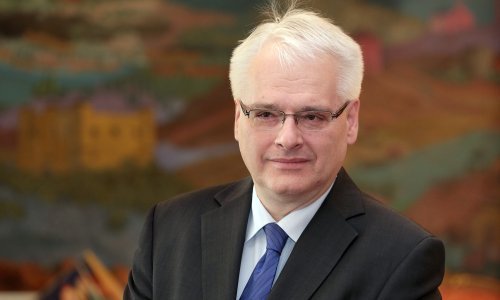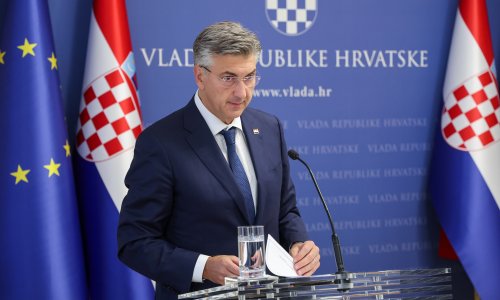
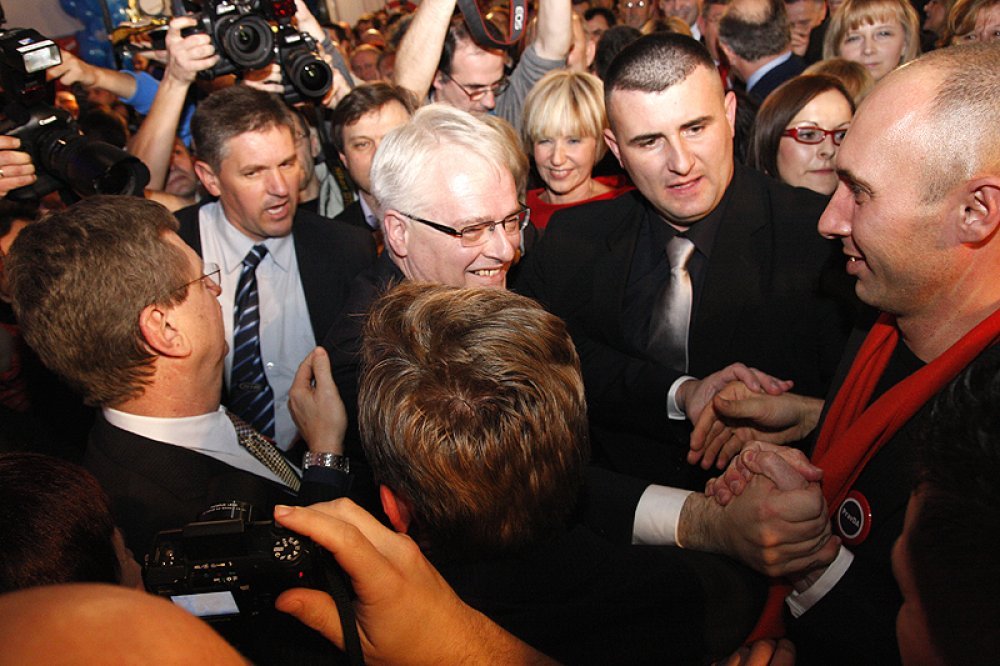

Speaking at his first news conference as Croatia's President-elect on Monday, Ivo Josipovic said that his priorities would be the fight against corruption and crime as a condition determining Croatia's future, both in terms of the economy and in terms of the country's future position in the European Union.
The newly elected president said the fight against corruption had obviouslybeen given "a new impetus in relation to previous times", but notedthat the anti-corruption effort had to be raised to a higher level.
"That is the most important task at the moment, a precondition forCroatia's admission to the EU, and an important step for Croatia'sfuture."
Josipovic said that corruption and crime obstructed necessary reforms,particularly in the economy whose development he said was very important forthe living standards of Croatian citizens. He pointed to the need to transformthe national economy from an import-oriented one to an export andproduction-oriented economy capable of paying the foreign debt and stimulatingenterprise.
For the rule of law to be entirely functioning, expeditious and efficientprotection of workers' rights is necessary, as one of the basic values ofsocial democracy, Josipovic said.
He went on to say that he would cooperate closely with the government, aswell as with the opposition.
"Both the government and the opposition will have a partner inme."
Croatia's second foreign political goal, following admission to the EU, isclose cooperation with neighbouring countries and the settlement of alloutstanding issues, said Josipovic.
"That is a matter of national security, because relations withneighbours define our national security to the greatest extent," Josipovicsaid, adding that good neighbourliness was also important for economicinterests because compatible regional economies would enable joint projects inthird markets.
Josipovic also said that Croatia's politics and statehood were based onanti-fascism and the Homeland War, and that he would therefore support theaffirmation of anti-fascism and of the dignity of Croatian Homeland Warsoldiers.
He went on to say that he would support making public the register of warveterans, adding that all participants in the defence war deserved respect, butthat one should make a distinction between those who carried arms in war andthose who were part of logistics.
Josipovic stressed that respect for human rights was one of the foundationsof democracy, an area in which he said Croatia had made significant progressbut still needed to work on the strengthening of religious freedoms and rightsof ethnic minorities.
"Croatia's legal and political system must be sensitive about humanrights," he said.
He said that in the course of the election campaign he had noticed that mostvoters expected a lot from the next president. "I am aware of that and Idon't see it as a burden, but as a duty," he said, adding that within hispresidential powers, as well as those of the political nature, he would do hisbest to justify their expectations that he would leave Croatia, once his termexpired, "a better country than it was when I won the elections".
Asked how he planned to unite the electorate that had become polarisedduring the election campaign, Josipovic said that those differences wereartificial, that there was a fabricated division into the red and the black,and that Croatia's tumultuous past had resulted in political pluralism and astate in which people did not think the same nor should they do so.
"I am confident that Croatian citizens, keeping their politicalpluralism, will come to realise that those differences are not so big orimpossible to overcome."
When asked how he would end his presidential oath, which ends with the words"So help me God", considering the fact that he is an agnostic,Josipovic said that he did not see any problem in that since he was elected bya majority of voters, most of whom declared themselves Catholic.
The President-elect said that in his opinion Croatia should not withdraw itsgenocide lawsuit against Serbia at the moment, and he also believed thatSerbia's counter-suit did not have any legal grounds.
He stressed that since Croatia's filing of the lawsuit Serbia had madeprogress regarding the issue of missing and imprisoned persons, the restitutionof cultural property stolen during the war in Croatia, and the prosecution ofwar criminals, but that an important problem remained unsolved - the arrest ofthe war-time Bosnian Serb army commander Ratko Mladic and the wartime CroatianSerb political leader Goran Hadzic.
Josipovic said he was confident that Serbia would accept Kosovo's statehoodas a reality sooner or later, but also expressed understanding for its specificattitude towards Kosovo.
When asked if he supported a political alliance of the ruling CroatianDemocratic Union (HDZ) and the opposition Social Democratic Party (SDP) in lightof the need to launch necessary reforms, Josipovic said that it was not up tothe head of state to shape the political scene, but that it should be done byleaders of the two strongest parties.
"If there is good faith in that, the president will be there tohelp," he said.
Josipovic repeated that he would be the president of all Croatian citizensand that he would cooperate with the government led by PM Jadranka Kosor to thebenefit of all citizens.