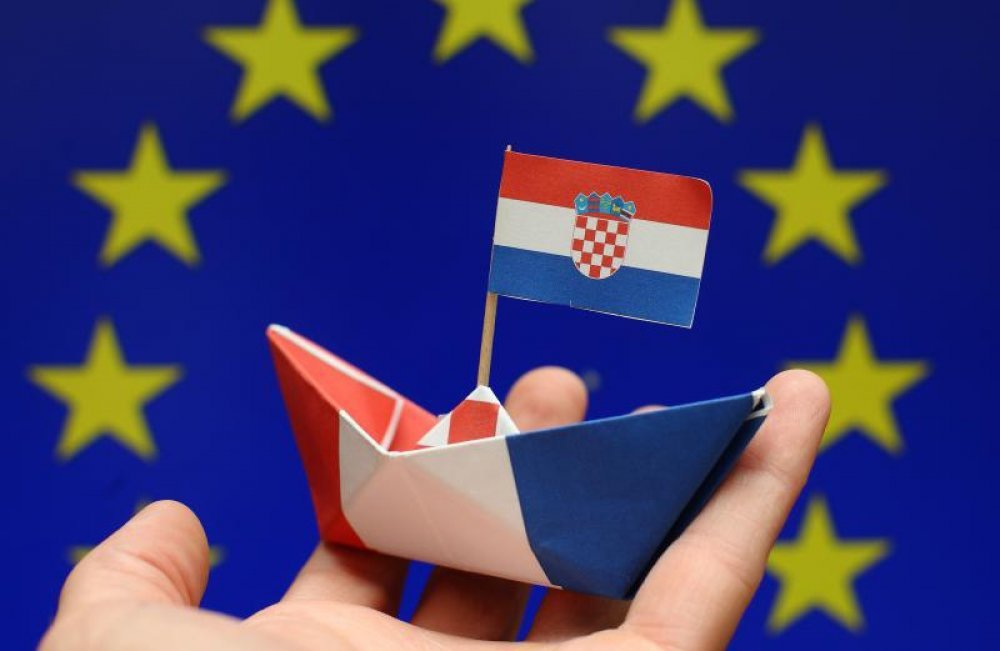

The Croatian government on Wednesday posted on its website the Croatian translation of the country's EU accession treaty, which will be signed in December and is the result of almost six years of negotiations.
The Croatian translation is still subject to legal and linguistic revision.
The government also uploaded the English-language draft accession treaty.
The 195-page text is divided into five sections, from treaty principles and adjustments to permanent and provisional regulations, and regulations on the implementation of the treaty.
The English draft was approved at a meeting of the EU Committee of Permanent Representatives on September 14 and three days later, Polish Prime Minister Donald Tusk brought it to Zagreb.
Before the signing, the accession treaty has to be translated into all EU official languages, then be approved by the European Parliament and formally approved by the Council of the EU. The European Parliament is expected to give its consent on December 1 and the Council on December 5. The place and date of the signing have not yet been chosen.
After the signing, the accession treaty has to be ratified by all EU member countries. Croatian citizens will voice their opinion on EU accession in a referendum. The treaty says that the deadline for the delivery of ratification documents to Italy, the depositary of the treaty, is 30 June 2013, and Croatia's accession is envisaged for 1 July 2013, whereby Croatia will become the EU's 28th member.
The accession treaty is the result of negotiations which lasted five years and eight months, from their launching on 3 October 2005 to their completion on 30 June 2011. Negotiations were held on 33 policy chapters of the EU acquis communautaire. Two chapters, "Institutions" and "Other Issues", are not negotiated.
The "Other Issues" chapter says that Croatia's compliance with commitments will be monitored until accession. The European Commission will carry out the usual monitoring that was applied to previous candidates. This autumn, the Commission will release a progress report and next autumn a monitoring report. Attention will focus on three policy chapters: "Judiciary and Fundamental Rights", "Competition Policy" and "Justice, Freedom and Security".
The "Institutions" chapter defines the participation of Croatian representatives in EU bodies. Croatian will become an official EU language from the moment of accession.
The most difficult policy chapters during the negotiations were "Judiciary and Fundamental Rights" and "Competition Policy", and "Agriculture and Rural Development", "Environment" and "Fisheries" were also demanding.
In the "Finance and Budgetary Provisions" chapter it was agreed, and this is now part of the accession treaty, that in the first six months of membership, in the second half of 2013, Croatia will have access to about EUR 800 million, but the funds cannot be drawn immediately but over a longer period of time, as most projects are being implemented a number of years. In the first six months of membership, Croatia will pay EUR 267.7 million into the European budget, meaning that for one euro paid, it gets three in return.
Croatia negotiated a transitional period of seven years during which foreigners will not be able to buy farmland, with the possibility of a three-year extension.
On the day of accession, Croatia will have to rescind the zero VAT rate but will be able to introduce minimum and lower rates.