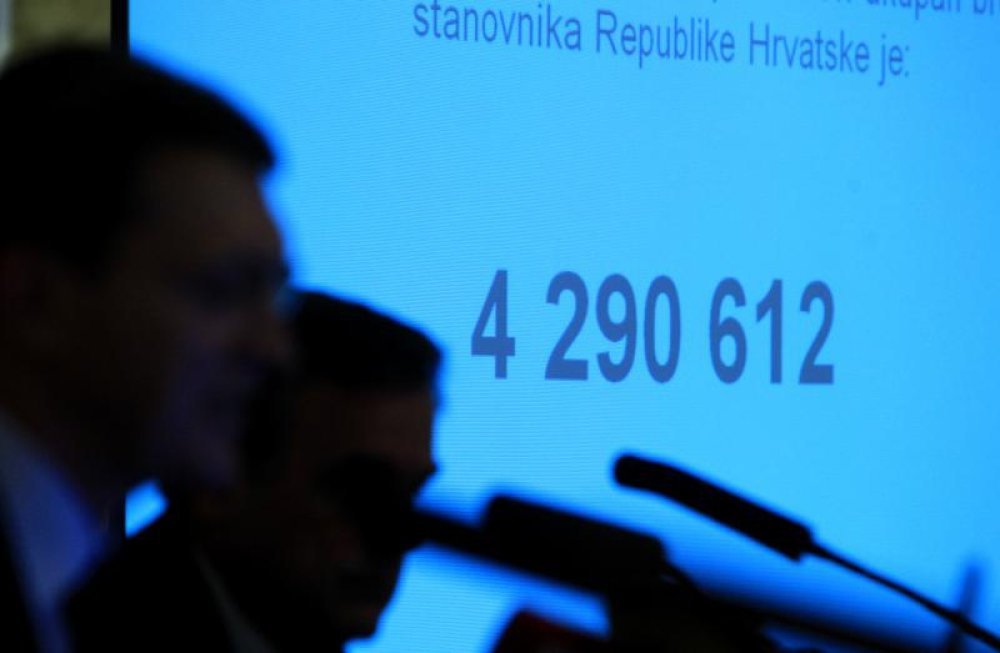

As of March 31, Croatia has 4,290,612 inhabitants, according to preliminary results of the 2011 census which the Central Bureau of Statistics presented on Wednesday.
The data is not comparable to the results of the 2001 census, as the methodology has in the meantime been aligned with international standards, said DSZ head Ivan Kovac.
According to the census conduced on April 1-15, 2001, Croatia had a population of 4,437,460 and a data comparison would indicate that it lost 146,848 inhabitants, but this is actually the result of the changed statistical definition of the total population.
If the latest methodology was applied to the results of the 2001 census, Croatia would now have nearly the same number of inhabitants as then, said Kovac.
The City of Zagreb has 792,875 inhabitants, or 18% of the entire population, followed by Split-Dalmatia County with 455,242 inhabitants. Lika-Senj and Pozega-Slavonia counties have the lowest population, 51,022 and 78,031 respectively. Apart from Zagreb, only Split, Rijeka and Osijek have a population of over one hundred thousand (178,192, 128,736 and 107,784 respectively).
The census also shows that Croatia has 1,535,635 households and 2,257,515 housing units, including 1,923,522 flats as permanent residences. The number of housing units grew 20 per cent in the last 10 years (by 376,648) and the bulk were built in Zagreb (73,421) and Split-Dalmatia County (64,277).
The complete and final results of the 2011 census will be released starting from 2012, Kovac said, adding that information on the population's ethnic and confessional structure would be released in the first half of 2012.